The Phantom’s cage
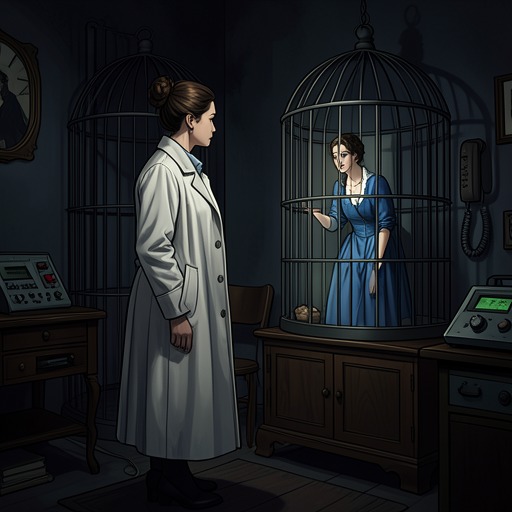
The CageThe Phantom’s cage is the loft enclosure in which Jill Richards is held and to which Zoe Hardy is brought. It gives the captor’s power a fixed, material form: Jill’s hands are tied to its wire, her movements are restricted, and the cage becomes the place where he enforces a routine of restraint and replaces one captive with another. When police reach it, Zoe is unconscious beside it and Jill is still tied inside; cutting its padlock opens the way to their rescue.
Physical Setting and Form
The cage occupies the loft of the house where Jill and Zoe are found. It dominates the space, making it the first striking feature of the room when Eve Strong climbs through the hatch. Access to the loft is concealed above the landing: Eve uses a long pole with a hook to pull down the hatch and lower its ladder. The enclosure is therefore not encountered from the street or the ordinary rooms below; reaching it requires the police to find and open a hidden route upward.
The available details make the cage’s physical construction plain without specifying its size or full design. In the dark, Jill tells Zoe to feel what her hands are tied to. Zoe gropes with limited movement and feels wire, as well as rope binding Jill to it. At the rescue, Jill’s wrists are tied to the sides, while a padlock secures the cage door. These materials are not incidental: wire, rope, and lock each mark a different restriction, from the enclosure itself to Jill’s bound body and the barrier between her and escape.
Captivity and Daily Use
The cage is incorporated into the captor’s repeated routine rather than used only as a place to keep Jill out of sight. After an episode in which she neither cooperates nor fights but endures, he gives her a new adult nappy and orders her back to the loft. She obeys, opens a sandwich box, eats the food, and drinks the water. When she has finished, he puts her back in the cage and follows his usual procedure to ensure she is properly restrained before leaving through the hatch.
That sequence shows how confinement reaches into the ordinary necessities of a day. Food and water arrive in a box, and Jill’s return to the enclosure follows the captor’s schedule and handling of her. She thanks him for the meal; he hesitates briefly as he leaves, then shuts the hatch and turns out the light. The cage is thus part of a controlled environment in which access to food, movement, darkness, and the route out of the loft all depend on him. The text does not present it as a neutral container: its use is bound to the captive’s enforced dependence.
Replacement and the Captor’s Language
The cage also gives physical expression to the captor’s claim that his victims are interchangeable. When Jill tries to understand how to keep him from turning against her, he rejects her attempt to present herself as a friend. He describes her as a thing and a convenience, says that he will get another captive when he is tired of her, and tells her she is merely keeping the place warm for something better. The threat makes the cage more than a single victim’s prison: it is a position in a succession that the captor expects to continue.
Jill explains that succession to Zoe in the dark. She tells her that the captor will kill her and that Zoe will take her place in the cage; Zoe asks what she means by a cage, and Jill guides her to the wire and rope. Jill also explains that he calls them dolls. The word reduces the women to objects in his possession, while the cage supplies the literal place where that reduction is enforced. Its occupants may change, but the captor’s pattern of restraint and replacement persists.
Discovery and Rescue
The investigation first has to bridge the distance between women’s last known movements and the concealed loft. Becky Allsopp’s journey from Newcastle Central Station toward Sunderland ends beyond the Stadium of Light CCTV coverage; Louise Usher might walk, take a bus, or occasionally use a taxi after the gym; Felicity Wanless leaves a pub before her friends and never gets home. With no reported cries or screeching tyres, investigators consider how women could have been taken into a vehicle without attracting notice. Later, CCTV shows Jill Richards leaving a supermarket, checking a bus timetable, and flagging down a car shaped like a black cab, though it has no sign on its roof. That sighting is troubling in light of the police warning to hail only white cars with a taxi sign.
At the house, the cage is reached only after the search moves from the downstairs rooms to the upper floor and then through the loft hatch. In the spare bedroom, Paul Forrester finds adult nappies and tunics like those worn by the women police have already found; Eve identifies the clothing as proof that they have the right place. The discovery establishes the house as part of the case, but the women are still missing. The cage above supplies the answer: Zoe calls for help and says she needs an ambulance, while she lies unconscious beside the enclosure and Jill remains tied inside.
Bill Nicol unties Zoe and then frees Jill’s wrists. Eve calls Gary Baxter for medical help and backup and asks for food to be brought for the women. Paul works at the padlock with cutters until it comes free and the cage door swings open. The progression from hidden hatch to locked enclosure to severed padlock turns the cage into the decisive point of the search: the object that had organised the captor’s control becomes the barrier the rescuers physically break.
Narrative Significance
The cage concentrates the story’s movement from uncertainty to proof. Early inquiries reconstruct ordinary journeys and the possibility of quiet abductions; those details establish how difficult it is to locate the point at which a woman disappears. The loft enclosure, once found, makes confinement visible in specific materials and practices: wire, rope, restraints, a locked door, and food delivered according to the captor’s routine.
Its meaning also shifts at the rescue. For the captor, the cage is a repeatable place where one woman can be kept until another takes her place. For Jill and Zoe, it is both the immediate fact of their confinement and the object through which they identify the danger they share. For the police, the locked door is finally something that can be cut open. That change does not erase what happened inside it, but it ends the cage’s practical power over the two women.